Meet ...

National Conservation Scientist Valentina Risdonne is setting up a world-leading Paint Sample Archive and Microscopy Centre at the Royal Oak Foundation Conservation Studio in Knole, Kent
I was the child who would break things up to see how they were made. Conservation science brings together my interest in how things work and my passion for the arts, and I knew from a young age that it was what I wanted to do. After studying for my degree in Italy, I moved to England for my PhD and then secured a role as a conservation scientist at the Victoria and Albert Museum. From there I became a lab manager at University College London.
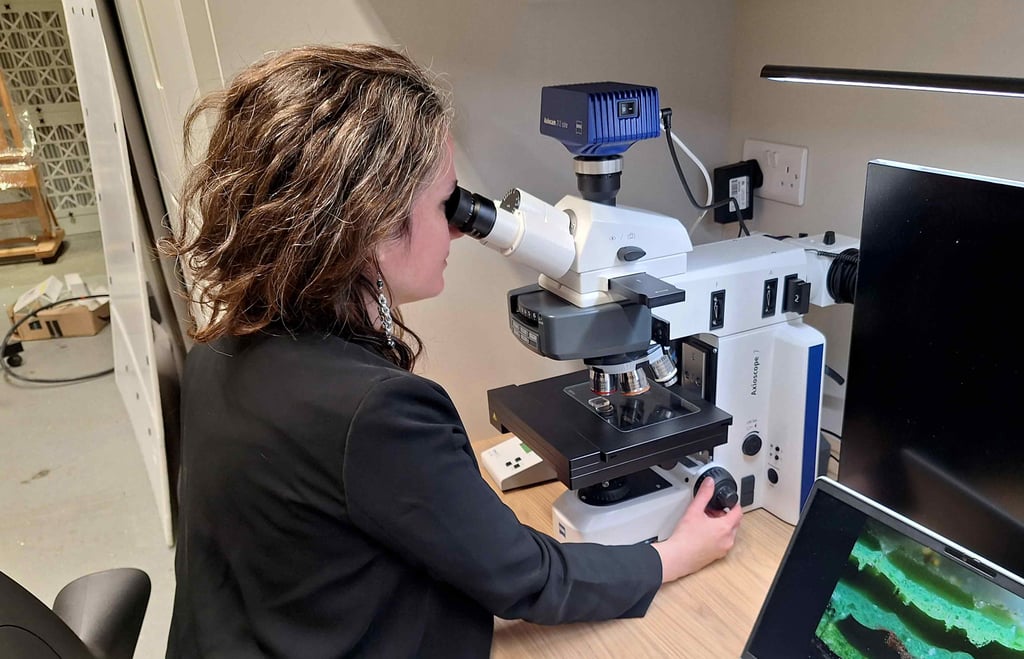
I’m now setting up a state-of-the-art paint archive and science facility at the Royal Oak Foundation Conservation Studio at Knole in Kent. The archive holds samples of paint from places around the Trust, as well as a Microscopy Centre – a laboratory space with equipment to analyse paint. By archiving paint samples and storing them properly, we can keep them safe for the future, while sharing the knowledge they hold about historic places and collections with others. When the archive opens next year it will be a valuable resource for people working in heritage, in the Trust and beyond.
We have 14,000 samples in the archive so far. They come from nearly every property around the Trust, from frescoes at Chedworth Roman Villa in Gloucestershire and the quintessential Arts and Crafts interiors of William Morris to priceless artworks by Jacopo Tintoretto and Joshua Reynolds.
Above The stratigraphy, or layers, of paint can reveal clues such as the period and provenance of a work.
The paint samples are tiny – often just 1mm across. We take them using a scalpel to cause as little damage as possible to the work. We describe this as being ‘microinvasive’ – it leaves a tiny hole but is not usually visible to the eye. We put the samples in a liquid resin, and once the resin has cured, we polish and expose the stratigraphy – layers – of the sample. It’s a bit like cutting through the layers of a cake. When you look at them under the microscope, the layers can offer clues about the period the work was made, its provenance, the manufacturing processes used to make it, and sometimes even the artist.
I always say heritage scientists don’t answer the questions, they teach you what questions to ask.
I work with curators, conservators and historians to understand more about a sample and its history. Then that context and combination of expertise and knowledge comes together to build the bigger picture.
The big ‘painting hiding under the painting’ reveals make for good stories, but they are quite rare. My work is more like that of a detective – gathering clues and connecting the dots. The stories the paint samples reveal might influence how conservators choose to look after an object or the decisions they make when they’re restoring historic places. For example, curators at the Bath Assembly Rooms, which are currently being restored ready to reopen in 2027, are using analysis of paint samples from the Card Room to help decide what colour it should be painted.
Once we’ve finished setting up the archive, we hope to share it with visitors through open days. I’m looking forward to showing people around the lab and sharing some of the stories the paint samples can reveal.
This work was supported by the Arts and Humanities Research Council (AHRC), part of UK Research and Innovation (UKRI), through the Research Infrastructure for Conservation and Heritage Science (RICHeS) programme.

Interview by Helen Beer. National Trust/Anna Vesaluoma, Lincoln Conservation

Contact us
General enquiries, including changing membership details:


0344 800 1895

Supporter Service Centre, National Trust, PO Box 7083, Stratford-upon-Avon, CV37 1XE

Leaving a lasting gift
Gifts in wills are vital to help us care for the places you love, from beautiful landscapes and coastline to historic properties. Every gift, no matter the size, makes a lasting difference in helping look after nature, beauty and history for future generations to enjoy.
Find out how to write or update your will using our free guide.
For everyone, for ever