Listen to this feature
IRONBRIDGE GORGE:
the next chapter
In March, the National Trust took over the management of the 10 museums, 550 hectares and 400,000 collection items that make up Shropshire’s world-famous Ironbridge Gorge. Curator Lauren Collier explains why the immersive World Heritage Site is known as the ‘birthplace of the Industrial Revolution’, and sets out what visitors can expect next from this new chapter in its history
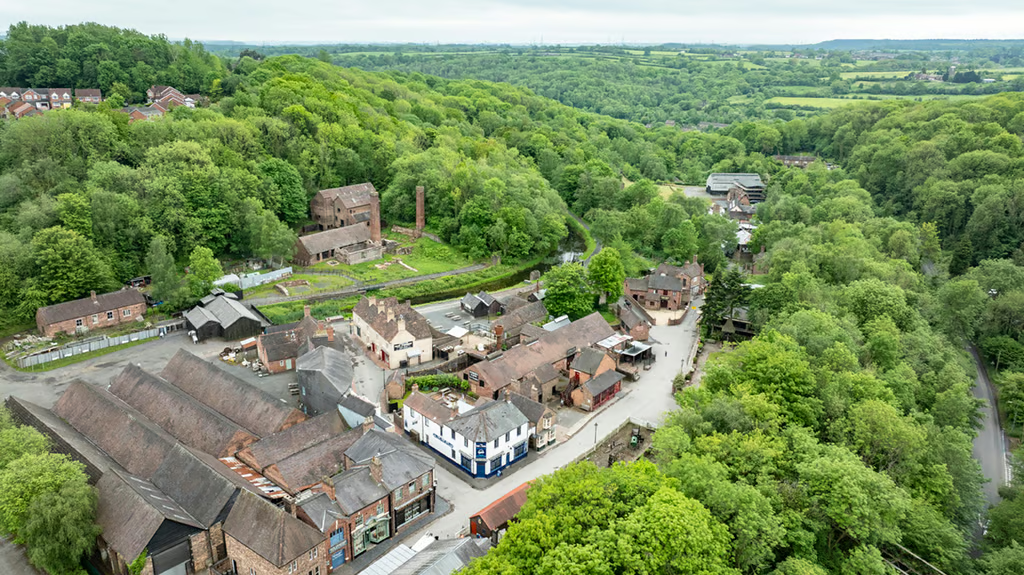
Above Blists Hill Victorian Town, in the Ironbridge Gorge, Shropshire, was once a booming industrial area
There’s a terrific breadth of stories, particularly working-class stories, which is quite unusual
hen Abraham Darby I arrived in Coalbrookdale, Shropshire, in 1708, he kick-started a chain of events that transformed the small riverside mining settlement into the birthplace of the Industrial Revolution.
At the time – 100 years before the birth of Isambard Kingdom Brunel, and 60 years before Richard Arkwright opened his first water-powered cotton mill – the UK’s manufacturing industries were generally small-scale and localised, with the economy still largely based on agriculture.
Darby was a skilled metalworker and an innovative businessman who learned his trade working in foundries in Bristol. He was drawn to Coalbrookdale because of the rich natural resources in the surrounding Gorge – particularly coal, iron ore, limestone and clay – and the opportunity to lease a blast furnace. Within a year of arriving and establishing the Coalbrookdale ironworks, Darby had pioneered an innovative new method of smelting iron using coke – a type of processed coal – instead of more expensive charcoal. Combined with his newly patented method of using moulds made of sand that could be easily mass produced, Darby’s breakthrough didn’t just improve ironmaking — it changed the course of history.
Iron products shifted from being scarce and costly to something that could be made cheaply, reliably and in vast quantities. Thanks to Darby’s innovations, it was now possible to build the machinery and infrastructure that would soon power the Industrial Revolution.
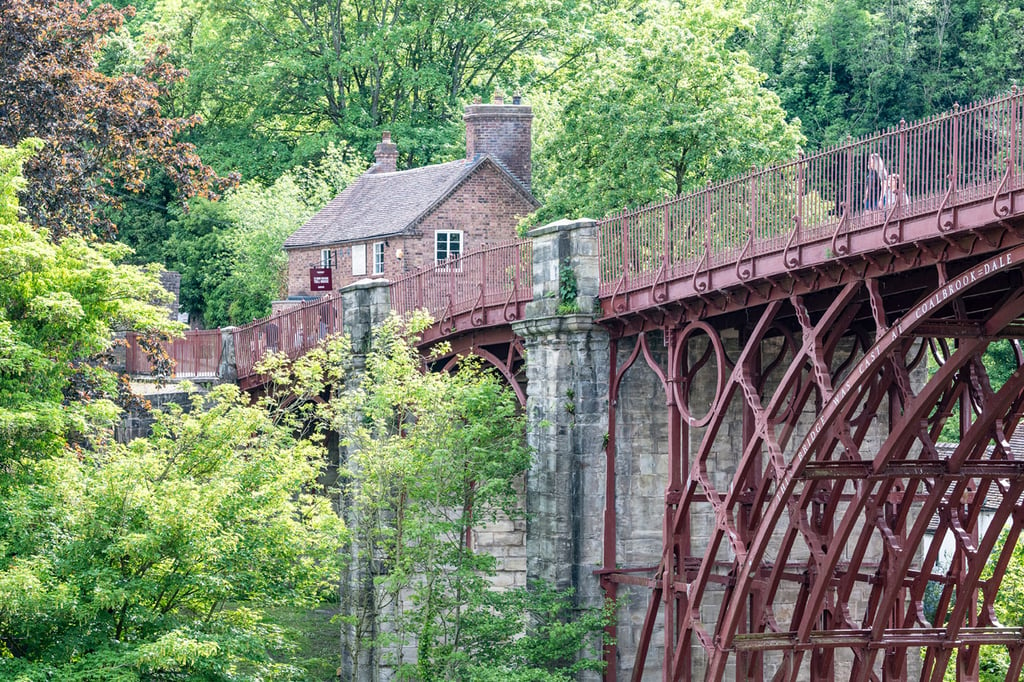
Building on Darby’s initial successes, his descendants branched out further. The Coalbrookdale Company produced iron products on a tremendous scale, beginning with the likes of cooking pots, iron rails and stationary steam engines in the 18th century and expanding to locomotives and decorative furniture in the 19th. In 1779 came the eponymous ‘Iron Bridge’ spanning the river just 500 metres downstream from Coalbrookdale. Designed by architect Thomas Farnolls Pritchard and built by Darby’s grandson, Abraham Darby III, the bridge transformed transport links in the Gorge, connecting industries on both sides of the river and allowing both materials and the factory workers to move around more easily, while the River Severn carried the finished goods by boat down to Worcester, Gloucester, Bristol and on to the rest of the world. With its pioneering design and construction, the graceful arch soon became a global advertisement for British engineering and the possibilities of cast iron.
Industry thrived at Ironbridge Gorge for more than two centuries, but shifting markets and the rise of steel took their toll. By the late 1960s, the factories had largely fallen silent. Yet there was a growing fascination with industrial heritage. With post-war development erasing historic sites, local campaigners recognised the Gorge’s importance and fought to preserve it.
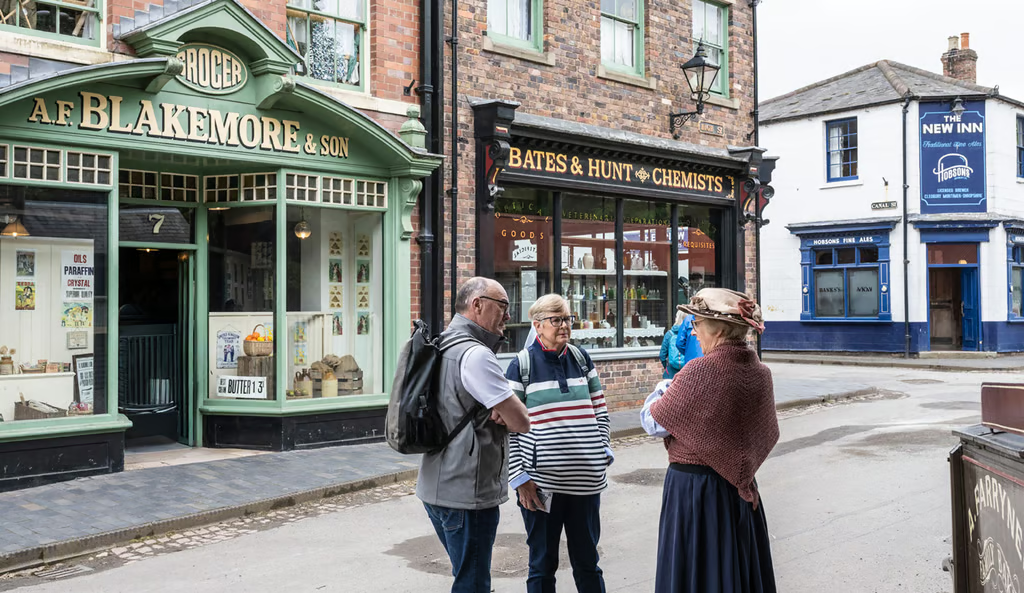
Above Chatting to a Blists Hill local from the 19th century
Their efforts led to the founding of the Ironbridge Gorge Museum Trust (IGMT) in 1968, followed by decades of excavation, acquisition and restoration to create the heritage site we know today. In 1986, Ironbridge Gorge was one of the first seven locations in the UK to be designated as a UNESCO World Heritage Site. English Heritage took over the management of its famous Iron Bridge and still looks after it today.
For nearly 60 years, IGMT cared for the Gorge’s museums, archives and collections. But by 2024, financial pressures and falling visitor numbers were threatening the future of the museums, and IGMT turned to the National Trust for help. The Trust receives moving offers from places at risk almost weekly and, much as it might like to, it can’t accept them all. But Ironbridge Gorge was different. Teams at the Trust immediately recognised it as a vital part of the UK’s industrial heritage that helped shape the world we live in today. Its unique collection of historic sites, with their pioneering ‘living history’ approach, have captured the imagination of generations of people, helping locals and visitors alike to see that history isn’t something that happened to other people in other places. It happened here, it’s still happening here, and it belongs to them.
The National Trust knew it was well placed to make sure Ironbridge Gorge’s unique blend of living industrial history could continue. Support from The National Lottery Heritage Fund and commitments from the Department for Culture, Media and Sport and Arts Council England helped secure the funds to safeguard the site for the future, and the museums and collections passed into the Trust’s care in March.
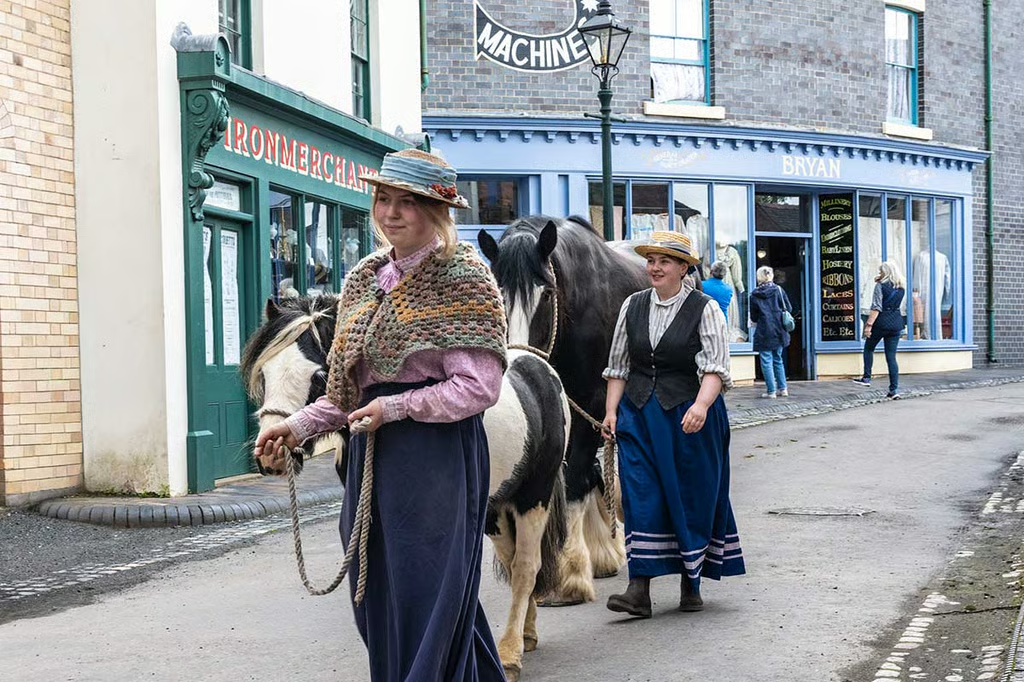
I’ve transferred across to the Trust after eight years working for IGMT, and I’m now working together with other former IGMT staff and new colleagues from the Trust to revitalise and expand the experience of visiting Ironbridge Gorge. We’re reopening the museums in phases, and there are currently four that you can visit, including Blists Hill – a living, breathing re-creation of a Victorian town. Walking through its streets, you might hear snatches of music-hall ballads drifting out of the pub, or meet Constable Jarrett, the friendly policeman on his daily rounds. Inside the printing shop you’ll find costumed interpreters at work on the presses. Follow your nose and it will lead you to the fried fish dealer on Canal Street, where you can tuck into fish and chips cooked in beef dripping and wrapped in newspaper.
Above A glimpse inside Coalbrookdale Museum of Iron
Above The old brickworks at Blists Hill
Ironbridge Gorge also helps to keep heritage craft skills alive. At Blists Hill, for example, you’ll find expert craftworkers demonstrating trades such as tinsmithing, blacksmithing and decorative plasterwork. Chandlers make candles using a traditional ‘nodding donkey’ – a rack which repeatedly dips hanging wicks into molten wax to build up layers.
We have a dedicated costume team who design and make every garment worn by the interpreters from scratch, using historic patterns where possible. They produce a huge variety of outfits, from Quaker dress to Victorian bathing suits, along with the day-to-day work of repairing and laundering dozens of outfits – although we do let them use modern washing machines rather than a Victorian washboard and mangle!
All the experiences at Ironbridge Gorge are underpinned by extensive research. We have a huge collection – about 400,000 objects – spanning industrial life in the 18th and 19th centuries. There’s also an enormous archive covering the various industries that were based here and how they operated, as well as local history – with photographs, oral histories and written accounts.
There’s a terrific breadth of stories, particularly working-class stories, which is quite unusual for a heritage site, and I think is one of the most exciting things that Ironbridge Gorge brings to the Trust. The records of a stately home often focus on just one or two families, who were usually wealthy and educated enough to record their own stories and amass collections that tell us about their lives. The Gorge has a much larger cast of characters, from miners and potters to pipe-makers and tile-painters, whose histories are often under-recorded elsewhere.
Ironbridge has the tagline of being the birthplace of the Industrial Revolution, but that comes with the undeniable consequences that industry has had on trade and colonialism, nature and climate change. Being part of the National Trust means we’ve not only safeguarded Ironbridge’s places, collections and landscapes for the future – we’ve also got a wider support network of other curators and experts with experience in researching and telling these broader stories.
We’re keeping the ‘fan favourites’. At Blists Hill you can still buy humbugs from the Victorian sweet shop and see George the Shire horse in harnessing demonstrations. But we’ll also be listening to ideas and feedback from visitors and the local community, as well as new audiences, to find out what they’d like to see.
The Gorge is still a place of making. One of the historic tile companies still leases part of its original factory from us; our teams still make ceramics at Coalport; and we regularly run hands-on creative activities, workshops and demos across the sites. That’s the beauty of Ironbridge Gorge. It’s immersive, creative and alive.
Above A candle-making demonstration at Blists Hill using a traditional ‘nodding donkey’
Lauren Collier
joined Ironbridge Gorge’s curatorial team in 2017, and now works as the Property Curator covering all 10 museums.
Explore the Gorge
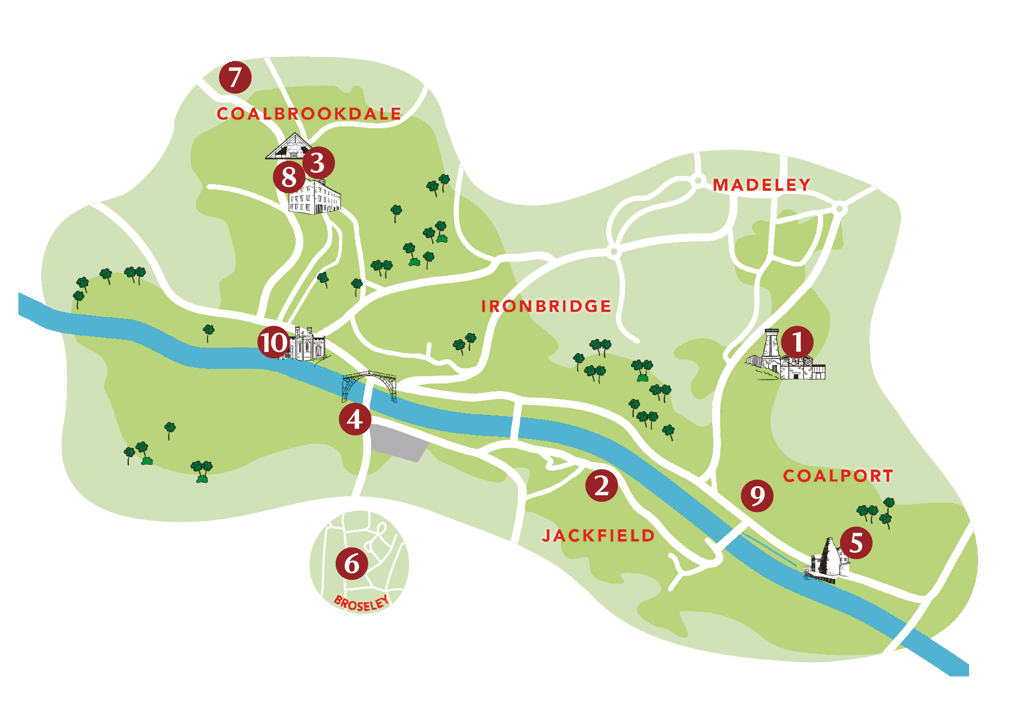
Here’s a taster of the 10 museums that bring the history of Ironbridge Gorge to life. Some of the museums are already open to visitors, with a phased reopening of the others over the next year. For the latest, including opening days and times, visit the Ironbridge Gorge website.
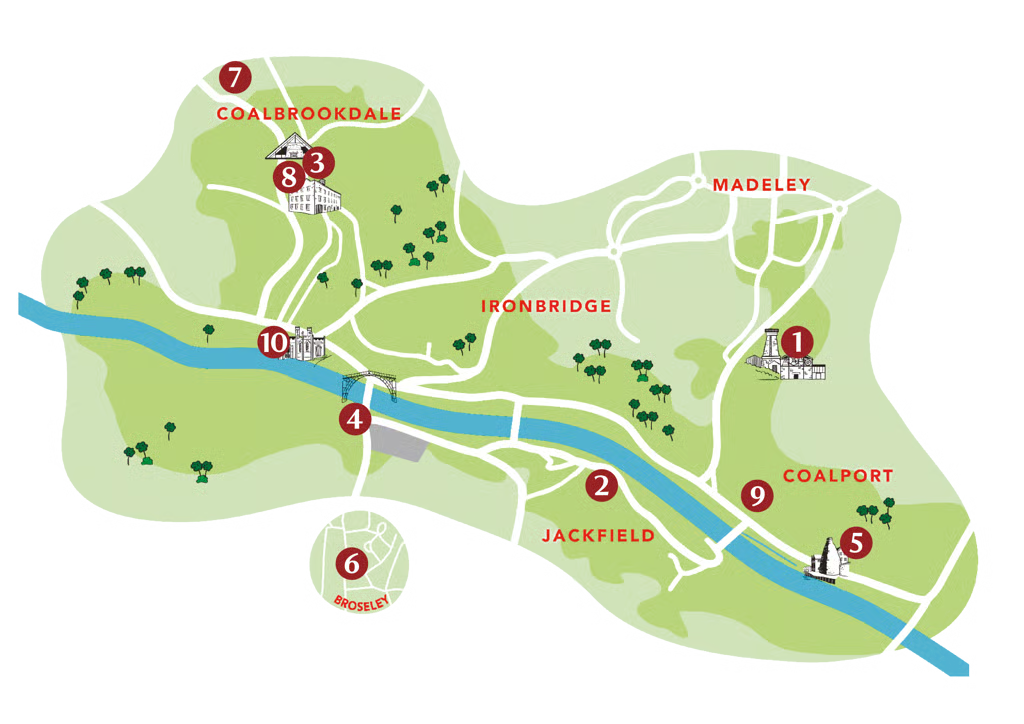
1
Blists Hill Victorian Town
Originally an ironmaking, mining and brickmaking site, Blists Hill was redeveloped between 1969 and 1973, and over the last 50 years has grown into today’s bustling ‘Victorian’ town. Many of the shops and cottages are historic buildings saved from demolition and moved brick by brick to the site. You can wander the streets, meet costumed characters and experience what life was like in the 19th century.

2
Jackfield Tile Museum
Once the world’s largest decorative tile works, this restored factory now showcases a vast collection of tiles and ceramics dating back to the 19th century. Many of the tiles on display were manufactured by Craven Dunnill or Maw & Co. Today you can learn how Jackfield tiles came to adorn grand buildings as far afield as Russia and the US, as well as local pubs and homes.
3
Museum of Iron and the Old Furnace
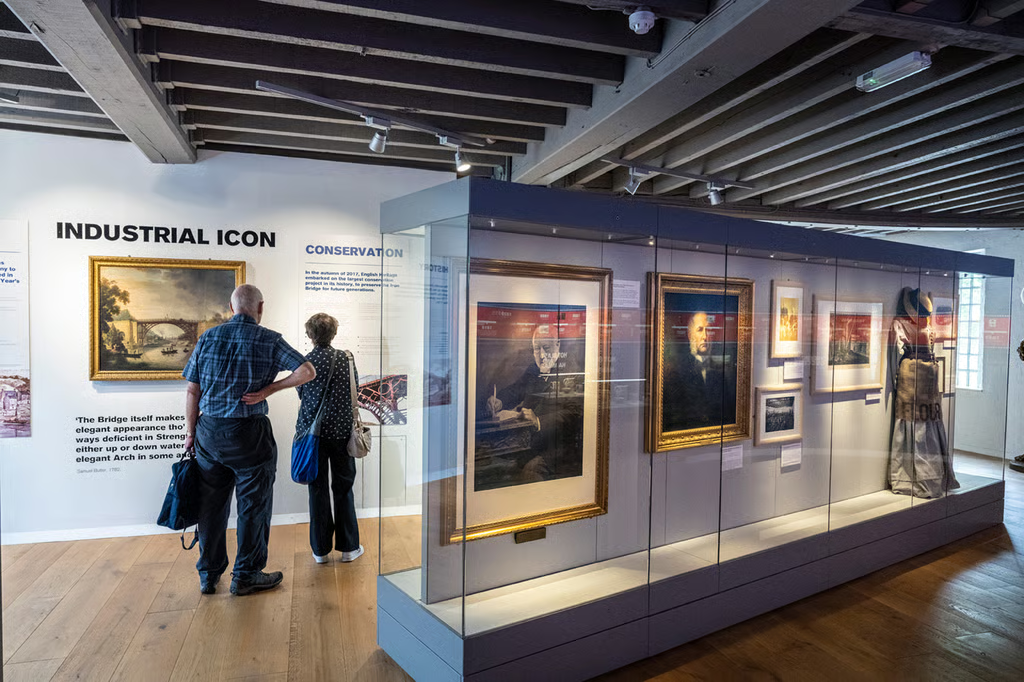
Head inside the Coalbrookdale Company’s ‘Great Warehouse’ to discover how Abraham Darby I’s iron smelting breakthrough helped spark the Industrial Revolution. Exhibits reveal Coalbrookdale’s global influence, from early rail lines and steam locomotives to ornate ironwork. Don’t miss the remains of Darby’s blast furnace, without which the world would look very different.
4
The Tollhouse
Take a stroll over the world’s first iron bridge to the Tollhouse, which was still active until the bridge passed into public ownership in 1950. Today it houses an exhibition explaining how and why the bridge was built, and its transformational impact on travel and engineering.
OPENING SEPTEMBER 2026
5
Coalport China Museum
Step inside the original Coalport china factory established by John Rose in 1796. For more than a century, its works were among the most successful of their kind anywhere in the world, picking up prizes at international exhibitions. When the museum reopens, visitors will be able to uncover stories of the craftspeople, techniques and designs that made Coalport so successful.


1/6


National Trust Images x7, Visit Telford

Contact us
General enquiries, including changing membership details:


0344 800 1895

Supporter Service Centre, National Trust, PO Box 7083, Stratford-upon-Avon, CV37 1XE

Leaving a lasting gift
Gifts in wills are vital to help us care for the places you love, from beautiful landscapes and coastline to historic properties. Every gift, no matter the size, makes a lasting difference in helping look after nature, beauty and history for future generations to enjoy.
Find out how to write or update your will using our free guide.
For everyone, for ever